
Adaptive Riding
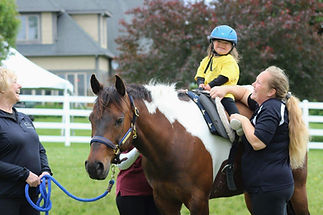
Our adaptive riding programming is tailored to provide optimum experiences for each student. All of our instructors are PATH certified and use a variety of methods to enhance participants' horsemanship skills as well as physical and cognitive abilities. Our gentle setting and our highly-trained herd have helped hundreds of children and adults move toward their full potential—and we look forward to helping many more.


Interested in learning more about our Adaptive Riding Program? Contact info@equicenterny.org or call 585-624-7777 for more information.
Support from all sides
Our instructors work closely with participants and their caregivers to develop individualized programming in accordance with their goals. To assure the best experience and optimal safety, each lesson is assisted by a trained volunteer team that leads the horse and walks alongside the rider to provide stability and support as needed.
Unconditional acceptance for all
Many who ride in our programs—and who are met with absolute support—have diagnoses such as:
-
ADD and ADHD
-
Autism Spectrum Disorder
-
Cerebral Palsy
-
Developmental Delay
-
Down Syndrome
-
Epilepsy
-
Friedreich’s Ataxia
-
Hypotonia
-
Intellectual Challenges
-
Multiple Sclerosis
-
Post-traumatic Stress
-
Spinal Cord Injuries
-
Stroke
-
Traumatic Brain Injury
-
Tourette’s Syndrome
-
Visual Impairment
Contraindications to Adaptive Riding
Unfortunately, riding is not an appropriate activity for everyone, and we may occasionally decline services for individuals for whom riding is contraindicated. As a PATH Premier Center (Professional Association of Therapeutic Horsemanship International), we must follow PATH guidelines. Some examples include:
-
Children under 2 years old
-
Moderate to severe osteoporosis
-
Atlantoaxial Instability (AAI) in Down Syndrome
-
Complete spinal cord injury above T-6
-
Coxarthrosis
-
Uncontrolled seizures
-
Limited head/neck control
-
Uncontrolled abusive behavior
-
Hypotonia to the point where an individual is unable to maintain an upright seated position

CLAIRE’S STORY
“Riding has benefited Claire in so many ways—
physically, socially, but mostly in how she sees herself.
It has been so gratifying to watch Claire's love affair
with her horses at EquiCenter, which has enriched
her life in so many unexpected ways.”
Carey M., Claire's mother